From wedge to bean: designing BOB's head
Several studies, one decision: a soft, rounded head with one big eye and a camera — designed in code, checked in Blender, made to be printed.
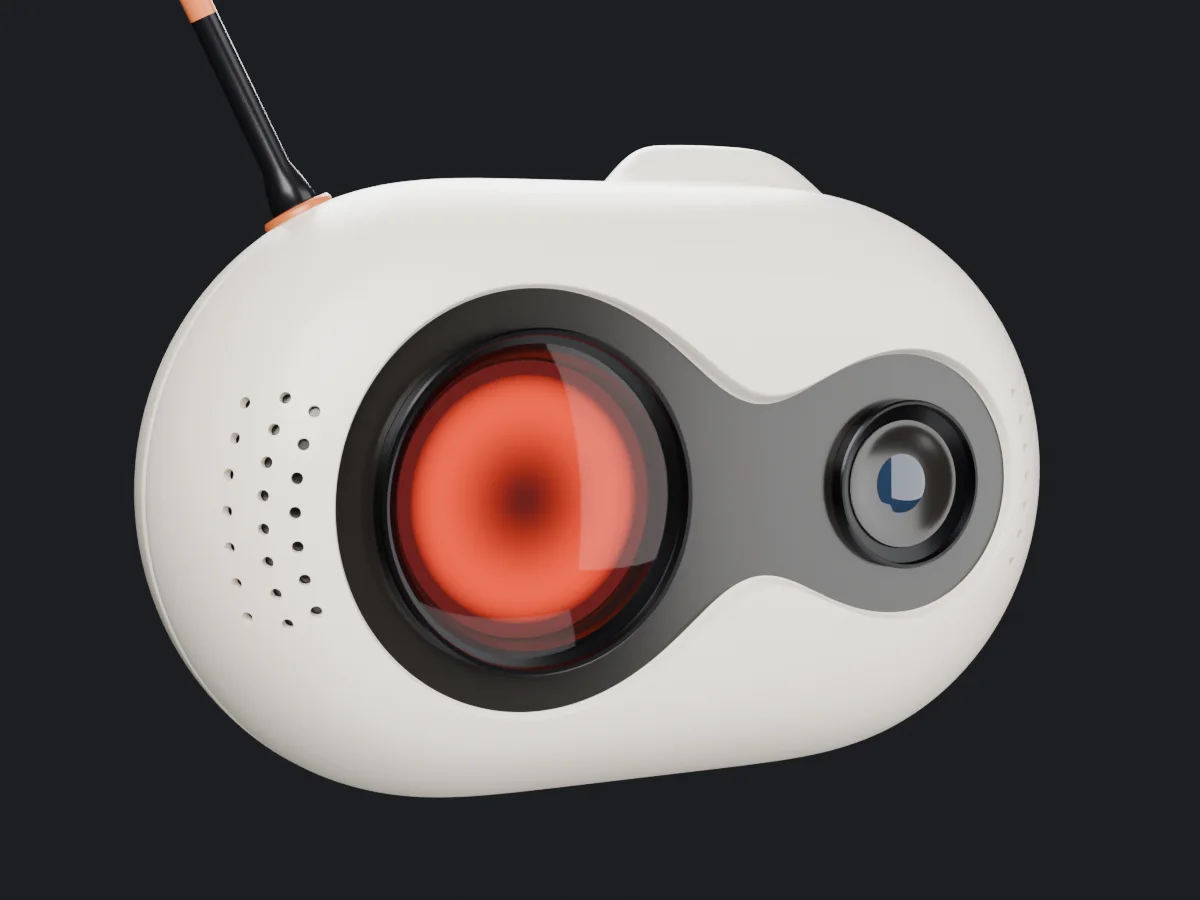
A face decides whether people talk to a machine or at it. So the head got more design time than any other part of MK-II.
The studies
We started with a sharp, angular wedge — easy to build from flat plastic sheets, but it looked more like a security camera than a companion. A kit-based robot was quick to try and quicker to drop: it never looked like BOB.
The design that stuck is a soft, rounded shell — a bean, if you like — with a figure-eight visor across the front:
- the left opening holds the round display that becomes BOB’s eye,
- the right one is a real camera,
- speaker grilles sit on both cheeks,
- and a small dome on top houses the environment sensors.
Built in code, checked in Blender
Every version of the head exists as code that generates the 3D model, so a change is a parameter, not a redraw. Each version is checked in Blender from all sides and measured against the real parts: the display has to sit flat, the camera needs room for its autofocus, the screws need something to bite into.
The shell will be 3D-printed by a friend with large-format printers; smaller inserts and parts of the neck are built by hand.
What it will look like in the real world, we’ll know soon. For now: a render, and a lot of measuring.
Follow the build: all entries · RSS feed